

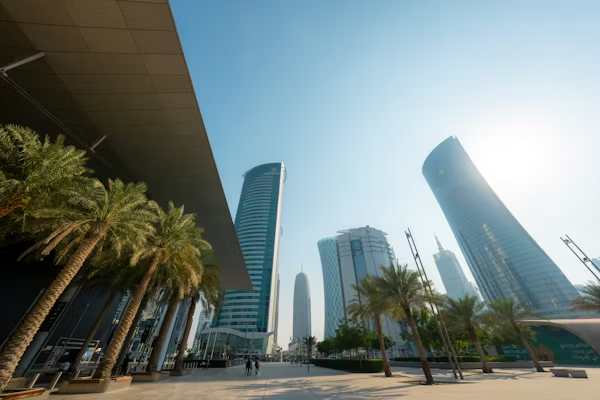
For nearly half a century, Gulf Contracting Company has been part of the physical vocabulary of Qatar. Its work does not announce itself with slogans or celebrity architects, yet its presence is unmistakable in the airports people pass through, the schools where students gather, the towers that reshape the skyline, and the infrastructure that quietly sustains daily life. Established in 1976, at a time when Qatar was still defining its post-oil future, the company grew alongside the country, translating national ambition into steel, concrete, and glass.
In the first decades after its founding, Gulf Contracting Company focused on the fundamentals: civil works, buildings, and essential facilities required by a rapidly developing state. Over time, it evolved into a Grade A contractor capable of delivering complex, high-value projects across aviation, education, healthcare, hospitality, residential, commercial, and industrial sectors. This evolution was not sudden. It was incremental, shaped by regulatory rigor, long-term client relationships, and a reputation for reliability rather than spectacle.
Within the first hundred words of any serious inquiry about Gulf Contracting Company, one truth emerges clearly: this is not merely a construction firm but an institutional actor in Qatar’s development story. Its trajectory parallels the country’s own shift from basic infrastructure provision to sophisticated, globally benchmarked urban development. As Qatar prepared for international milestones and articulated long-range national visions, Gulf Contracting positioned itself as a builder that could keep pace—technically, organizationally, and culturally.
This article examines that journey: how the company grew, what it built, how it organized itself, and why its story offers insight into the broader mechanics of Gulf-region development.
Origins in a Formative Era
Gulf Contracting Company was founded in 1976, a period when Qatar’s construction sector was still taking shape. Oil and gas revenues were beginning to translate into public infrastructure, but the scale and complexity of projects were modest by today’s standards. Contractors were expected to deliver reliably in a challenging environment marked by limited local supply chains, nascent regulatory frameworks, and a workforce drawn from many countries.
In this environment, the company’s early success depended on discipline more than innovation. Meeting deadlines, adhering to specifications, and maintaining working relationships with government entities and private developers were essential. Over time, these fundamentals earned Gulf Contracting Company higher classifications and access to more demanding projects.
Achieving Grade A contractor status marked a decisive turning point. It signaled regulatory trust and opened doors to large-scale developments that required financial stability, technical competence, and proven management systems. This status was not symbolic; it imposed obligations related to quality assurance, safety, and execution capacity that shaped the company’s internal culture.
As Qatar’s ambitions expanded, Gulf Contracting’s portfolio expanded with them, moving beyond basic construction into projects that demanded coordination across multiple engineering disciplines.
Building a Diversified Construction Portfolio
One of the defining characteristics of Gulf Contracting Company is the breadth of its work. Rather than specializing narrowly, the company cultivated the ability to deliver across sectors, reflecting the diversified nature of Qatar’s development agenda.
In aviation, the firm contributed to facilities associated with the country’s international gateways, including executive and premium terminal environments. These projects required not only structural expertise but also sensitivity to operational continuity, security protocols, and architectural finishes that reflect national identity.
Educational facilities formed another pillar of the company’s work. Schools, colleges, and training centers demanded durability, adaptability, and compliance with international standards. These projects reinforced the idea that construction is inseparable from social investment; buildings were not endpoints but platforms for learning and workforce development.
Healthcare-related projects, while often less visible, required stringent adherence to safety and quality standards. Even relatively modest facilities, such as medical support structures, involve complex coordination between engineers, regulators, and operators.
Commercial and mixed-use developments arguably had the most visible impact on urban form. High-rise towers, hotels, retail complexes, and corporate offices reshaped Doha’s skyline and reflected Qatar’s emergence as a regional business hub. Gulf Contracting Company’s role in such projects placed it within a competitive ecosystem where execution quality directly influenced reputation.
Integrated Capabilities and Subsidiary Expertise
As projects grew more complex, the company responded by integrating complementary capabilities rather than outsourcing them entirely. Subsidiaries and specialized units allowed Gulf Contracting Company to offer more comprehensive services while maintaining control over quality and timelines.
Modular and prefabricated construction solutions addressed efficiency challenges and labor constraints. Interior fit-out capabilities ensured continuity between structural delivery and final user experience. Joinery and finishing services added another layer of vertical integration, particularly important in high-end commercial and hospitality projects.
This structure reflected a strategic understanding of the market. Clients increasingly favored contractors who could reduce interface risks by coordinating multiple phases of delivery under a single organizational umbrella. For Gulf Contracting Company, integration became not just a technical advantage but a commercial one.
Safety, Standards and Organizational Culture
Behind the physical output of any construction company lies an internal culture that determines how work is done. Gulf Contracting Company placed sustained emphasis on safety, quality management, and environmental responsibility, aligning its internal systems with internationally recognized standards.
Health, Safety, Security, and Environment frameworks were embedded into daily operations rather than treated as compliance exercises. On active sites, safety protocols shaped workflows, training programs, and supervision structures. This approach acknowledged the inherent risks of construction work and the moral and operational imperative to minimize them.
Quality assurance systems played a similar role. Consistency across projects—regardless of scale or sector—reinforced client trust and reduced long-term liabilities. Over time, these systems became part of the company’s identity, influencing recruitment, training, and performance evaluation.
The workforce itself reflected Qatar’s multicultural labor landscape. Engineers, managers, technicians, and skilled workers from diverse backgrounds collaborated within structured hierarchies. Managing this diversity required clear communication channels, standardized procedures, and an organizational ethos that balanced authority with accountability.
Navigating a Competitive and Cyclical Market
Construction in the Gulf is neither linear nor predictable. Economic cycles, energy prices, geopolitical shifts, and government spending priorities all influence the flow of projects. Gulf Contracting Company operated within this volatility, competing with both regional contractors and global engineering firms.
Larger multinational EPC companies often dominate mega-projects, particularly in oil, gas, and heavy infrastructure. For a firm like Gulf Contracting Company, competitiveness lay in flexibility, local knowledge, and long-standing relationships rather than sheer scale.
Strategic partnerships played a role in navigating this landscape. Collaborations with international firms allowed knowledge transfer and access to specialized expertise while preserving local execution capacity. Such arrangements reflected a pragmatic approach to growth: selective expansion rather than overextension.
Alignment with National Vision and Urban Transformation
Qatar’s articulation of long-term development strategies placed infrastructure at the center of national planning. Education, healthcare, transportation, and urban development were framed not merely as services but as foundations for economic diversification and social stability.
Gulf Contracting Company’s work aligned naturally with these priorities. Educational campuses supported human capital development. Transportation and aviation facilities reinforced global connectivity. Commercial and residential developments accommodated population growth and economic activity.
This alignment did not require overt branding. It emerged organically through the types of projects undertaken and the standards applied. In this sense, the company functioned as an intermediary between policy ambition and physical realization.
The Human Dimension of Building
Construction narratives often focus on structures, but the human dimension remains central. Each project involved thousands of individual decisions made by engineers, supervisors, and workers under real-world constraints.
For many employees, long careers within the company provided stability in an otherwise transient industry. Institutional memory accumulated, informing best practices and reducing repeated mistakes. This continuity distinguished the firm in a market often characterized by rapid turnover.
Communities, too, felt the impact indirectly. Schools, hospitals, and public facilities altered daily life in ways that statistics cannot fully capture. In this sense, Gulf Contracting Company’s legacy is not only architectural but social.
Conclusion
Gulf Contracting Company’s story is not one of sudden disruption or dramatic reinvention. It is a story of steady adaptation, institutional learning, and alignment with a nation’s evolving priorities. From its origins in the 1970s to its role in shaping contemporary Qatar, the company exemplifies how construction firms can function as long-term partners in national development.
Its buildings may not always carry its name, but they carry its imprint: in the precision of execution, the discipline of systems, and the quiet confidence of experience. As Qatar continues to navigate the balance between growth, sustainability, and global integration, companies like Gulf Contracting Company remain essential—not as symbols, but as enablers.
Frequently Asked Questions
What is Gulf Contracting Company known for?
It is known for delivering diverse construction projects across aviation, education, healthcare, residential, and commercial sectors in Qatar.
When was Gulf Contracting Company established?
The company was founded in 1976 during Qatar’s early phase of infrastructure development.
What does Grade A contractor status mean?
It signifies the highest contractor classification in Qatar, allowing execution of large, complex projects.
Does the company offer integrated construction services?
Yes, it provides construction, modular solutions, interior fit-outs, and specialized finishing through integrated capabilities.
How does the company approach safety?
Safety is embedded into operations through structured HSSE systems aligned with international standards.