

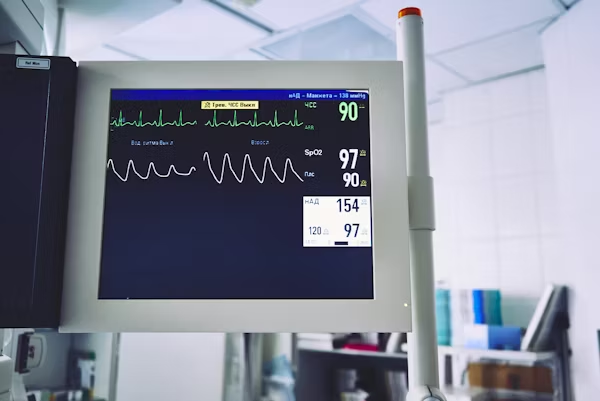
Every year, thousands of patients undergo complex cardiovascular procedures that can save lives but carry serious risks, particularly internal bleeding. Traditionally, clinicians detect these complications indirectly—through vital signs, symptoms, or imaging performed after the procedure. This delay often limits timely intervention and increases the risk of severe outcomes. Saranas, a Houston-based medical technology company, has introduced a breakthrough solution: the Early Bird® Bleed Monitoring System, the first FDA-cleared device capable of detecting internal bleeding in real time during endovascular procedures. By giving clinicians immediate alerts of potential bleeding events, the system enables interventions before complications escalate, offering patients a safer path through complex procedures.
Founded in 2013, Saranas focuses on large-bore interventions, such as transcatheter aortic valve replacement (TAVR), endovascular aneurysm repair (EVAR), and procedures involving mechanical circulatory support. These procedures carry significant bleeding risks, with complications affecting roughly 20% of patients. Early Bird’s technology represents a shift from reactive care to proactive management, aiming to reduce morbidity, hospital stay lengths, and healthcare costs.
The system integrates bioimpedance sensors into vascular access sheaths used during procedures. These sensors detect electrical changes associated with blood accumulation outside the vessel wall and alert clinicians through audible and visual signals. In this article, we explore the origins, technology, clinical impact, challenges, and future directions of Saranas and its innovative Early Bird system.
Origins of Saranas
Internal bleeding remains one of the most significant complications in interventional cardiovascular procedures. Traditionally, clinicians have relied on indirect monitoring and post-procedure imaging to detect hemorrhage. Recognizing this gap, Saranas set out to create a device capable of detecting bleeding as it occurs.
The Early Bird system is based on bioimpedance technology. By measuring electrical resistance changes around the vascular sheath, it detects blood that collects outside vessels—a marker of early bleeding. When thresholds are exceeded, clinicians receive immediate alerts, providing a window for timely intervention that can prevent severe complications.
The company’s early milestones included gaining FDA de novo clearance in 2019, enabling commercial launch in U.S. hospitals. This milestone marked the arrival of a device that could change the management of bleeding in large-bore endovascular procedures.
Technology and Functionality
The Early Bird system integrates seamlessly into existing procedural workflows. Unlike external monitors or post-procedure imaging, its sensors are built into the vascular sheath, which is already standard in procedures. This design eliminates additional procedural complexity while enhancing safety.
Bioimpedance sensing measures the electrical resistance of surrounding tissues. When blood escapes the vessel, resistance decreases, triggering alerts to the clinical team. The system combines visual and auditory cues, allowing clinicians to respond immediately, even amid the complex dynamics of the operating room.
Engineering the device required balancing sterility, flexibility, and compatibility with procedural requirements. The result is a device that works unobtrusively, providing real-time feedback without disrupting existing workflows. Clinicians report that the device adds a layer of confidence during high-stakes procedures, supplementing their judgment with data-driven alerts.
Clinical Evidence and Impact
Clinical trials and early applications suggest the Early Bird system may improve both patient outcomes and economic efficiency. The SAFE-MCS trial examined the device’s impact during high-risk procedures using mechanical circulatory support. Early data indicate that the device’s alerts often precede traditional clinical signs, allowing faster intervention and potentially reducing adverse outcomes.
Bleeding complications are costly, with estimates of $18,000 per incident and national costs in the hundreds of millions annually. By enabling early detection, the Early Bird system has the potential to lower these costs while improving patient safety. Hospitals have recognized its value through contracts and awards, including innovative technology programs that support adoption and dissemination.
Commercial Growth and Funding
Saranas has expanded through venture funding and strategic partnerships. In 2021, the company completed a $12.8 million Series B funding round led by Baird Capital, supporting commercialization, clinical trials, and evidence generation.
The company has secured contracts with hospital networks, including Premier Inc.’s Technology Breakthroughs program, expanding access to the Early Bird system across thousands of hospitals. Leadership changes, including the appointment of CEO Mike MacKinnon in 2023, reflect Saranas’s focus on scaling operations and integrating its technology into standard practice.
Challenges and Critiques
Despite promising technology, adoption faces challenges. Hospitals must weigh cost against reimbursement models that do not always incentivize preventive monitoring. Clinician education and workflow integration are necessary to ensure effective use.
Some critics highlight that broader randomized trials are needed to demonstrate definitive outcome improvements. Additionally, the device’s utility outside large-bore procedures remains under investigation, though the technology may eventually extend to other surgical domains.
Future Directions
Saranas continues to innovate, developing next-generation devices that extend real-time bleed monitoring to a broader range of procedures and access sizes. As minimally invasive interventions expand, demand for real-time complication monitoring will grow, and devices like Early Bird may become standard tools for ensuring procedural safety.
Preventive, real-time monitoring aligns with the broader shift in medicine toward anticipating complications rather than reacting to them. As adoption grows and technology evolves, real-time sensing could become a standard across interventional and surgical specialties, improving patient safety on a larger scale.
Conclusion
Saranas exemplifies how technological innovation can address critical gaps in patient care. By providing real-time monitoring of internal bleeding, the Early Bird system transforms how clinicians manage procedural risk, offering earlier intervention and potentially improving outcomes.
While further evidence and adoption will determine its ultimate impact, Saranas’s work underscores a fundamental shift in healthcare: moving from reactive treatment toward predictive, preventive, and data-driven care. In this evolving landscape, the Early Bird system represents not just a device but a model for the future of patient safety in interventional medicine.
FAQs
What is Saranas?
Saranas is a medical device company specializing in real-time detection of internal bleeding during high-risk cardiovascular procedures.
What is the Early Bird system?
The Early Bird system detects internal bleeding through sensors in vascular sheaths, alerting clinicians immediately during procedures.
How does the device improve outcomes?
By providing early alerts, clinicians can intervene quickly, potentially reducing complications, hospital stays, and costs.
Is the Early Bird system widely available?
Yes, the system is adopted by numerous hospitals and supported by group purchasing programs for broader access.
What is next for Saranas?
The company is developing next-generation devices to expand bleed monitoring across a wider range of procedures and access sizes.