

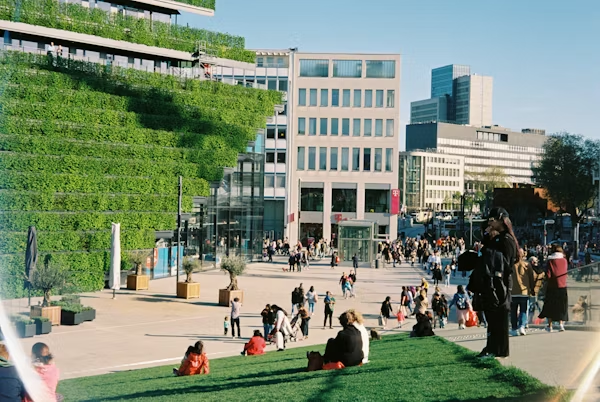
Every day begins inside a designed environment. The light that enters a bedroom, the distance between a home and a workplace, the sound of traffic or birds outside a window — none of these elements are accidental. They are the result of decisions made by planners, architects, engineers, technologists, and policymakers, often decades earlier. Together, they form what can be described as designable environments: spaces intentionally shaped to influence how people feel, behave, interact, and thrive.
In the first hundred moments of a day, environments already guide human outcomes. A walkable street encourages movement. Natural light regulates circadian rhythms. Quiet spaces restore attention, while chaotic ones drain it. The idea behind designable environments is not decorative ambition, but functional purpose — recognizing that space itself is an active force in human life.
The concept draws from environmental design, urban planning, psychology, public health, and technology. It reflects a growing understanding that environments are not neutral backdrops. They affect recovery rates in hospitals, learning outcomes in schools, productivity in offices, social trust in neighborhoods, and mental health across populations. As societies confront climate change, population growth, urban density, and digital transformation, the design of environments becomes inseparable from questions of equity, sustainability, and human dignity.
Designable environments do not imply total control over behavior. Instead, they acknowledge influence. They ask how intentional spatial choices can support healthier, more inclusive, and more resilient ways of living. In that sense, the environments we design today quietly script the experiences of generations to come.
The Concept of Designable Environments
Designable environments are spaces — physical, sensory, or digital — that are deliberately structured to support specific human and ecological outcomes. While the term itself is relatively new and interdisciplinary, its foundations are deeply rooted in environmental design and urban theory.
Environmental design has long focused on integrating functionality, aesthetics, sustainability, and human needs into the built environment. Unlike purely architectural approaches that emphasize form, environmental design examines how people move through, perceive, and emotionally respond to space. It considers lighting, acoustics, materials, scale, access, and environmental impact as interconnected variables rather than isolated features.
The idea of designability rests on agency. It asserts that environments are not fixed realities but malleable systems that can be adjusted, evaluated, and improved. A street can be redesigned to prioritize pedestrians. A classroom can be reconfigured to support collaboration. A digital platform can be structured to encourage meaningful interaction rather than distraction.
In this framework, design becomes a form of intervention — subtle but powerful — shaping daily behavior without coercion. The goal is alignment: between space and human need, between environment and long-term sustainability.
Evidence-Based Design and Measurable Outcomes
One of the most influential drivers of designable environments is evidence-based design. This approach insists that design decisions should be grounded in empirical research rather than intuition or tradition alone.
Evidence-based design gained prominence in healthcare settings, where researchers observed measurable links between environmental conditions and patient outcomes. Access to daylight, views of nature, reduced noise, and intuitive layouts were shown to shorten hospital stays, reduce stress, and improve recovery. These findings challenged the assumption that medical outcomes depended solely on clinical care.
Over time, the approach expanded into schools, workplaces, and public spaces. In educational environments, classroom acoustics, lighting quality, and spatial flexibility were linked to attention and learning. In offices, ergonomic layouts and access to natural elements were associated with productivity and reduced burnout.
What distinguishes evidence-based design is not just its reliance on data, but its accountability. Environments are evaluated against outcomes: health metrics, cognitive performance, user satisfaction, and behavioral patterns. Design becomes iterative, responsive to new findings rather than static.
At the same time, practitioners acknowledge complexity. Human behavior cannot be reduced to simple cause-and-effect relationships. Culture, socioeconomic conditions, and individual differences all interact with spatial design. Evidence-based design, at its best, informs decisions without oversimplifying human experience.
Urban Spaces and the Human Experience
Cities are among the most consequential designable environments. Urban design determines how people encounter one another, access resources, and move through daily life. Streets, parks, transit systems, and public buildings collectively shape social interaction and opportunity.
Well-designed urban environments prioritize human scale. This means walkable distances, visible sightlines, accessible entrances, and spaces that feel welcoming rather than overwhelming. When cities are designed primarily for vehicles or efficiency, human presence becomes secondary. When they are designed for people, public life flourishes.
Public spaces serve as social infrastructure. Parks, plazas, libraries, and markets create opportunities for informal interaction across social boundaries. These encounters build trust and community identity in ways that cannot be legislated.
Urban design also carries ethical weight. Historically, poor design and planning decisions have reinforced inequality, concentrating environmental burdens such as pollution and noise in marginalized communities. Designable environments must confront this legacy by prioritizing equitable access to clean air, green space, safe housing, and mobility.
In this context, design becomes a civic responsibility — shaping not just how cities look, but who they serve.
Conscious and Adaptive Cities
An emerging evolution of urban design is the concept of conscious or adaptive cities. These environments integrate data, behavioral insights, and technology to respond dynamically to human activity.
Unlike traditional smart cities that focus on efficiency and automation, conscious cities emphasize human experience. Sensors, analytics, and adaptive systems are used to understand how people use space and how environments affect mood, stress, and social interaction.
Examples include lighting systems that adjust based on pedestrian presence, public spaces that adapt to weather and usage patterns, and transportation systems that respond to real-time demand. The goal is responsiveness rather than rigidity.
However, adaptive environments raise important ethical questions. Data collection must respect privacy and consent. Design should empower users rather than surveil them. A truly conscious environment is one that listens without intruding and adapts without controlling.
When implemented responsibly, adaptive design holds the promise of environments that evolve alongside their inhabitants rather than lag behind them.
Biophilic Design and Ecological Integration
Biophilic design reflects the idea that humans possess an inherent affinity for nature. Modern life, particularly in dense urban settings, often suppresses this connection. Designable environments seek to restore it.
Biophilic design incorporates natural elements such as vegetation, water, natural light, and organic materials into built spaces. These features are not decorative extras; they have measurable psychological and physiological effects. Exposure to nature reduces stress, improves mood, and enhances cognitive function.
In cities, biophilic principles appear in green roofs, urban forests, daylight-filled buildings, and pedestrian corridors lined with vegetation. These elements also serve ecological functions, supporting biodiversity, managing stormwater, and reducing urban heat.
The integration of human well-being and environmental sustainability is central here. Designable environments recognize that human health and ecological health are deeply interconnected, not competing priorities.
Sound, Sensory Design and the Invisible Environment
Vision dominates most discussions of design, but environments are experienced through all senses. Sound, in particular, plays a critical role in shaping comfort and perception.
Soundscape design moves beyond noise reduction toward intentional auditory environments. Rather than treating sound as a problem to eliminate, it considers which sounds should be amplified, softened, or masked. Natural sounds, such as water or wind, can be emphasized to create restorative atmospheres.
In workplaces, acoustic design supports concentration and collaboration. In healthcare settings, reducing disruptive noise improves patient rest and recovery. In public spaces, carefully designed soundscapes can make environments feel calmer and safer.
These invisible aspects of design remind us that environments are felt as much as they are seen.
Digital and Virtual Environments
Designable environments extend beyond physical space into digital and virtual realms. Online platforms, collaborative tools, and virtual simulations all shape human behavior through design choices.
Digital environments influence attention, interaction, and emotional response. Layout, navigation, feedback systems, and visual hierarchy determine whether users feel empowered or overwhelmed. In educational and professional contexts, well-designed digital environments support collaboration, learning, and focus.
Virtual environments, including simulations and immersive experiences, rely on spatial principles similar to physical design: scale, orientation, lighting, and narrative cues. The line between physical and digital environments continues to blur as remote work and virtual interaction become more prevalent.
The same ethical considerations apply. Digital environments should support well-being, inclusivity, and agency rather than exploit attention or reinforce inequity.
Inclusion, Equity and Human-Centered Design
A defining measure of successful designable environments is inclusivity. Spaces must accommodate diverse abilities, ages, cultures, and socioeconomic backgrounds.
Human-centered design emphasizes empathy and participation. It involves users in the design process, ensuring that environments reflect lived experience rather than abstract assumptions. Accessible entrances, clear wayfinding, safe public transit, and flexible spaces are expressions of this philosophy.
Equity-focused design addresses historical disparities by redistributing environmental benefits. Access to green space, safe housing, and clean infrastructure should not depend on income or geography.
Designable environments, when guided by equity, become tools for social repair as well as functionality.
Challenges and Limitations
Despite their promise, designable environments are not panaceas. Design alone cannot solve structural inequality, political conflict, or economic instability. There is a risk of overstating the power of space while underestimating systemic forces.
There is also the danger of design determinism — assuming that certain environments will automatically produce desired behaviors. Human agency, culture, and choice remain central.
Technological integration introduces further challenges, from data privacy to algorithmic bias. Responsible design requires transparency, accountability, and ongoing evaluation.
Conclusion
Designable environments represent a shift in how society understands space. No longer passive settings, environments are recognized as active participants in human life, shaping health, behavior, relationships, and opportunity.
From hospitals and schools to cities and digital platforms, intentional design can support well-being, sustainability, and equity when guided by evidence, empathy, and ethics. The challenge is not simply to design more, but to design better — with humility, inclusivity, and long-term responsibility.
As the pressures of urbanization, climate change, and digital transformation intensify, the environments we choose to design will quietly define the quality of life for generations. In shaping space, we shape possibility.
FAQs
What are designable environments?
They are intentionally shaped physical or digital spaces designed to influence human behavior, comfort, health, and sustainability.
How does evidence-based design work?
It uses scientific research to guide design decisions, linking environmental features to measurable human outcomes.
Why is biophilic design important?
It reconnects people with nature, reducing stress and improving mental and physical well-being.
Are digital spaces considered environments?
Yes. Digital platforms and virtual spaces shape behavior and experience through design choices.
Can design improve social equity?
Design alone cannot solve inequality, but inclusive, equitable environments can reduce barriers and expand access.