

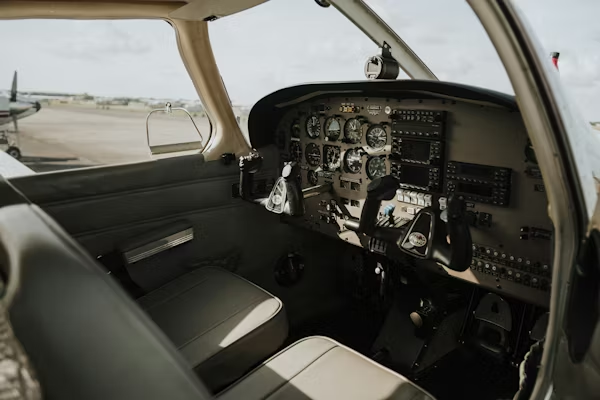
Air travel, at its best, feels effortless. Lights soften as the cabin settles into cruise. Entertainment systems respond instantly to a tap. Safety features remain invisible, yet reassuringly present. These moments of calm and coherence are not accidental. They are the result of deeply engineered systems designed to function flawlessly in one of the most demanding environments humans regularly inhabit. At the center of this invisible architecture sits Heads Up Technologies, a company whose influence is felt in aircraft cabins around the world, even if its name rarely is.
Heads Up Technologies is not an airline, nor an aircraft manufacturer. Instead, it operates in the crucial space between design and experience, supplying the systems that define how aircraft interiors function. Lighting, cabin management, audio, in-flight entertainment, and safety products form the backbone of its portfolio. Together, these systems shape how pilots interact with their environment and how passengers experience long hours in the air.
Founded in 1985 in Texas, the company has grown from a modest aerospace electronics operation into a global supplier serving original equipment manufacturers and aircraft operators. Over time, it has expanded both organically and through strategic acquisitions, assembling a suite of capabilities that reflect the changing priorities of aviation itself: integration over fragmentation, experience alongside safety, and innovation grounded in reliability.
In an era when aviation is increasingly judged not only by efficiency but by comfort, personalization, and technological coherence, Heads Up Technologies offers a case study in how specialized engineering quietly reshapes an entire industry. This article explores its evolution, its products, and its place within the broader story of modern flight.
Origins and Evolution in Aerospace Engineering
Heads Up Technologies emerged during a period when aviation technology was rapidly advancing but aircraft interiors often lagged behind. Early systems were functional but disconnected, designed to meet regulatory requirements rather than human experience. The company’s early focus on aircraft electronics positioned it well to respond as airlines and private operators began demanding more refined interior solutions.
From its base in Texas, Heads Up gradually built a reputation for reliability and customization. Rather than offering one-size-fits-all components, the company worked closely with clients to tailor systems to specific aircraft models and operational needs. This approach aligned well with business aviation, where differentiation and bespoke design play a central role, but it also proved valuable as commercial aviation began to rethink cabin design.
Over the decades, the company’s scope expanded. Lighting systems became more sophisticated, audio systems more immersive, and control interfaces more intuitive. What once might have been considered auxiliary equipment evolved into core components of the flight experience. By focusing on this intersection of engineering precision and human comfort, Heads Up Technologies carved out a durable niche within aerospace manufacturing.
Lighting as Both Function and Atmosphere
Lighting is among the most underestimated elements of flight. Beyond simple illumination, it affects mood, alertness, and even physical comfort. Heads Up Technologies has made lighting a central pillar of its work, developing systems that balance aesthetics with stringent safety requirements.
Cabin lighting systems are designed to support different phases of flight, shifting in intensity and tone to align with takeoff, cruise, meal service, and rest. Emergency and floor path lighting, meanwhile, must remain instantly visible under extreme conditions, including smoke-filled cabins or power loss scenarios. These systems are engineered to function reliably under vibration, pressure changes, and temperature fluctuations that would quickly degrade conventional electronics.
The company’s lighting solutions also reflect broader industry concerns around sustainability and efficiency. Modern LED systems consume less power, generate less heat, and offer longer service life than earlier technologies. For operators, this translates into lower maintenance costs and improved environmental performance, without compromising passenger comfort.
Cabin Management and In-Flight Entertainment Systems
As passengers increasingly expect the digital responsiveness of everyday devices while in the air, cabin management and in-flight entertainment systems have become defining features of modern aircraft interiors. Heads Up Technologies addresses this demand through integrated CMS and IFE solutions that unify control and content delivery.
These systems allow passengers to interact with entertainment, lighting, and environmental settings through intuitive interfaces. For crew members, centralized control panels simplify operations, reducing complexity while improving reliability. The emphasis is on integration: lighting, audio, and entertainment are designed to function as parts of a cohesive whole rather than isolated systems.
This approach reflects a broader shift within aviation toward user-centered design. Rather than forcing passengers and crew to adapt to rigid systems, modern cabins adapt to human behavior. Touchscreens, wireless connectivity, and modular components allow for upgrades and customization, extending the useful life of aircraft interiors in a rapidly changing technological landscape.
Audio Systems in a Challenging Environment
Sound behaves differently at altitude. Aircraft cabins are acoustically complex spaces, shaped by engines, airflow, and confined architecture. Delivering clear, immersive audio under these conditions requires careful engineering.
Heads Up Technologies’ audio systems are designed specifically for aviation environments, balancing clarity with restraint. Public address systems must be intelligible without being intrusive, while entertainment audio should feel immersive without bleeding into neighboring seats or sections. Achieving this balance involves both hardware design and careful tuning, informed by an understanding of cabin acoustics.
For premium and private aircraft, audio quality becomes part of brand identity. A well-designed sound environment contributes to the perception of luxury and care, reinforcing the idea that every detail has been considered.
Safety Systems That Remain Invisible Until Needed
Safety is the foundation upon which all aviation technology rests. Heads Up Technologies’ safety products, particularly emergency lighting and signage, are engineered to perform under the most adverse conditions imaginable.
Photoluminescent exit path markings and emergency signage provide guidance even in complete darkness, requiring no external power source. These systems are designed to activate instinctively, offering clear visual cues during moments of stress when cognitive load is high and time is limited.
While passengers may never consciously notice these features, they represent a critical layer of protection. Their effectiveness lies precisely in their unobtrusiveness during normal operations and their clarity during emergencies.
Growth Through Strategic Integration
Rather than expanding indiscriminately, Heads Up Technologies has pursued growth through targeted acquisitions that complement its core strengths. By bringing specialized companies into its orbit, it has expanded its capabilities while maintaining a focus on integrated solutions.
This strategy reflects a recognition that modern aircraft interiors demand coherence. Lighting, audio, and control systems increasingly overlap in function and influence. By aligning these disciplines under one organizational umbrella, Heads Up reduces friction for clients and simplifies the design and certification process.
Backed by private equity investment, the company has been able to scale its operations while continuing to invest in research, development, and talent. This balance between financial support and technical focus has allowed it to remain competitive in a market dominated by much larger aerospace firms.
The Human Element Behind the Systems
Behind every lighting sequence and control interface are teams of engineers, designers, and technicians grappling with the realities of flight. Components must withstand constant vibration, electromagnetic interference, and strict regulatory scrutiny. At the same time, they must be intuitive, aesthetically pleasing, and easy to maintain.
Installation and maintenance teams value systems that are modular and well-documented. Downtime is costly in aviation, and components that simplify upgrades and repairs offer tangible operational advantages. Heads Up Technologies’ emphasis on serviceability reflects an understanding that innovation must extend beyond initial installation to the entire lifecycle of an aircraft.
Positioning Within the Future of Aviation
The future of aviation points toward greater connectivity, personalization, and data integration. Cabins are becoming smarter, capable of adapting lighting and entertainment to individual preferences or flight conditions. Cockpits are increasingly defined by advanced displays that enhance situational awareness and reduce pilot workload.
While Heads Up Technologies is not primarily known for head-up displays themselves, its work exists within the same conceptual framework: presenting information and environmental control in ways that support human performance. As emerging technologies such as artificial intelligence and augmented reality enter the aviation space, the demand for thoughtful interface design will only grow.
The company’s challenge will be to continue evolving without sacrificing the reliability that has defined its reputation. In aviation, innovation is meaningful only when it earns trust.
Conclusion
Heads Up Technologies occupies a unique position in the aviation ecosystem. It does not command attention through branding or spectacle, yet its systems quietly shape how flight feels, sounds, and functions. From lighting that eases passengers through time zones to safety systems that stand ready in silence, its work underscores the idea that the best technology often disappears into the experience it creates.
As aviation continues to evolve, the importance of integrated, human-centered systems will only increase. In meeting that demand, Heads Up Technologies demonstrates how specialized engineering, strategic growth, and attention to detail can leave a lasting imprint on an industry defined by precision and trust.
FAQs
What is Heads Up Technologies known for?
It is known for designing and supplying aircraft lighting, cabin management, audio, in-flight entertainment, and safety systems.
When was Heads Up Technologies founded?
The company was founded in 1985 in Texas.
Who uses Heads Up Technologies products?
Its systems are used by aircraft manufacturers, airlines, and private aviation operators worldwide.
Why are integrated cabin systems important?
Integration improves reliability, simplifies maintenance, and creates a more seamless passenger and crew experience.
Does Heads Up Technologies focus on sustainability?
Its modern systems emphasize energy efficiency, long service life, and reduced maintenance requirements.