

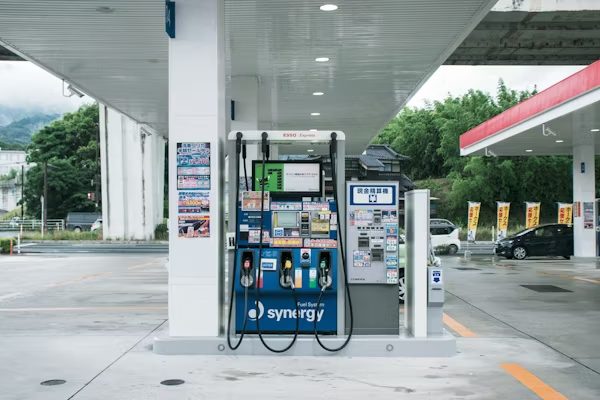
For more than a hundred years, Wayne Fueling Systems has occupied a peculiar place in modern life. It is everywhere and almost nowhere at once — present at tens of thousands of fueling stations across continents, yet rarely noticed by the motorists who depend on its technology. When a driver lifts a nozzle, watches numbers climb on a digital display, taps a card, and drives away within minutes, the smoothness of the experience masks generations of engineering decisions quietly embedded in steel, software, and circuitry.
Wayne’s story is inseparable from the story of modern mobility. Founded in the late nineteenth century, long before gasoline stations became fixtures of daily life, the company helped standardize how fuel is measured, dispensed, priced, and paid for. Its early innovations made fueling visible and trustworthy at a time when automobiles were novelties and skepticism was common. Later, its electronic and digital systems transformed fueling stations into sophisticated retail and data environments, responding to rising demands for speed, security, and operational efficiency.
Today, Wayne Fueling Systems operates as part of Dover Fueling Solutions, a global platform that reflects both continuity and change. While internal combustion engines still dominate much of the world, the energy transition is reshaping expectations around infrastructure, regulation, and technology. Wayne’s evolution — from mechanical pumps to connected site automation — offers a revealing lens through which to understand how legacy industrial companies adapt, survive, and sometimes lead in moments of profound transformation.
A Company Born Before Gas Stations Existed
Wayne Fueling Systems traces its origins to 1891, a period when fuel meant kerosene, not gasoline, and automobiles were rare curiosities. The company began as a manufacturer of pumps designed to measure and dispense kerosene accurately, addressing a basic but critical problem of trust between seller and buyer. Accuracy mattered, and so did visibility.
These early years established a pattern that would define Wayne’s identity: practical innovation driven by real-world needs. Rather than chasing novelty, the company focused on solving problems that constrained adoption — how to measure fuel precisely, how to reassure customers, how to make transactions fair and repeatable. Recognition at major exhibitions helped cement its reputation, but it was steady engineering refinement that secured its place in a rapidly industrializing economy.
As gasoline-powered vehicles began to replace horse-drawn transport in the early twentieth century, Wayne adapted quickly. In 1907, it introduced its first gasoline pump, marking a decisive pivot toward the emerging automotive age. A decade later came one of its most influential contributions: the visible gasoline pump. By allowing customers to see fuel flowing into a glass cylinder before it entered their vehicle, Wayne addressed widespread mistrust and helped normalize fueling as a routine activity.
Engineering Trust in the Early Automotive Era
The visible pump did more than reassure customers — it reshaped the social contract between station owners and motorists. Fueling became transparent, measurable, and standardized, accelerating public confidence in gasoline retailing. This emphasis on trust would remain a recurring theme in Wayne’s design philosophy.
As automobiles became more common, the complexity of fueling grew. Different fuel grades, fluctuating prices, and higher volumes demanded more sophisticated equipment. Wayne responded with mechanical computing dispensers capable of calculating totals automatically, reducing human error and speeding transactions. These machines bridged the gap between purely mechanical systems and the electronic controls that would emerge decades later.
Throughout the mid-twentieth century, Wayne’s equipment spread internationally, following the expansion of road networks and vehicle ownership across Europe, Asia, and beyond. Each market presented unique regulatory standards and environmental conditions, requiring adaptability rather than uniformity. Wayne’s willingness to tailor solutions to local requirements helped establish it as a trusted global supplier.
From Mechanical Craft to Electronic Intelligence
By the late twentieth century, the fueling station was no longer just a place to buy gasoline. It had become a retail environment, often paired with convenience stores, loyalty programs, and increasingly complex payment systems. Wayne’s transition from mechanical engineering to electronic intelligence reflected this shift.
One of the most consequential developments was the customer-activated terminal, which enabled pay-at-the-pump fueling. This innovation transformed consumer behavior, reducing lines inside stores and enabling true self-service. For operators, it offered higher throughput and reduced staffing demands. For customers, it offered speed and autonomy.
Electronic displays replaced mechanical counters, while embedded computing enabled real-time pricing, inventory tracking, and diagnostics. Wayne’s dispensers became nodes in a broader technological network, capable of communicating with point-of-sale systems, back-office software, and eventually cloud-based platforms.
The Forecourt as a Digital Ecosystem
As fueling stations grew more technologically complex, managing them became a challenge of integration. Isolated systems — pumps, payment terminals, price signs, tank gauges — needed coordination. Wayne’s response was a shift toward site automation, most visibly embodied in its Fusion platform.
The Fusion site automation server unified multiple systems under a single operational framework. Instead of managing each component separately, operators gained a centralized view of site performance, inventory, alerts, and transactions. Remote diagnostics reduced downtime, while software updates and configuration changes could be deployed without on-site intervention.
This transformation mirrored broader trends across industries, where hardware increasingly served as a foundation for software-driven services. Fueling infrastructure, once defined by steel and hydraulics, became data-rich and remotely manageable. Wayne’s large installed base allowed it to scale these capabilities globally, embedding digital intelligence into everyday fueling operations.
Global Reach, Local Complexity
Wayne Fueling Systems’ global presence spans more than 140 countries, with manufacturing and operations across North America, Europe, Asia, and South America. This scale is not merely a matter of distribution; it reflects deep engagement with local standards, payment cultures, and regulatory frameworks.
Fueling in one country may emphasize speed and automation, while another prioritizes attendant-based service or alternative payment methods. Environmental regulations, safety requirements, and fuel compositions vary widely. Wayne’s ability to operate within this diversity has been central to its longevity.
The company’s global footprint also exposes it to the uneven pace of technological change. In some regions, traditional fuel infrastructure remains dominant. In others, electric vehicle charging and alternative fuels are gaining ground. Wayne’s challenge — and opportunity — lies in serving both worlds simultaneously.
Becoming Part of Dover Fueling Solutions
A significant turning point came in 2016, when Wayne Fueling Systems became part of Dover Fueling Solutions, a business unit of Dover Corporation. The acquisition consolidated several major fueling technology brands under a single organizational umbrella, creating a comprehensive provider of fueling and energy infrastructure solutions.
For Wayne, integration into DFS offered access to broader resources, expanded research and development capacity, and closer alignment with complementary technologies. It also reflected an industry trend toward consolidation, as scale and interoperability became increasingly important in serving global customers.
Rather than erasing Wayne’s identity, the acquisition positioned it as a foundational brand within a larger ecosystem — one that could support everything from traditional fuel dispensers to emerging energy solutions.
Innovation in an Era of Energy Transition
The future of fueling is no longer defined solely by gasoline and diesel. Electric vehicles, hydrogen, LNG, and biofuels are reshaping expectations around infrastructure. For a company with roots in mechanical pumping, this shift poses existential questions.
Wayne’s response has been pragmatic rather than ideological. Through DFS, it has expanded its portfolio to support alternative energy dispensing and integrated site management systems capable of handling multiple energy types. While EV charging differs fundamentally from liquid fueling, the operational challenges — uptime, payment, monitoring, customer experience — remain familiar.
This continuity allows Wayne to leverage its historical strengths while adapting to new technologies. Rather than abandoning its past, the company is translating decades of operational knowledge into new contexts.
The Human Dimension of Invisible Technology
Despite its industrial focus, Wayne’s work has always been deeply human. Fueling stations are transitional spaces — places people pass through on the way to somewhere else. The technology must work flawlessly, quietly, and intuitively. When it fails, frustration is immediate and personal.
Wayne’s emphasis on reliability, safety, and ease of use reflects an understanding of this human dimension. Visible pumps built trust. Pay-at-the-pump systems saved time. Automation reduced errors. Each innovation addressed not only operational efficiency but also the lived experience of everyday users.
In this sense, Wayne’s history is a study in humility. Its success lies not in brand recognition but in seamless integration into daily life.
A Legacy of Adaptation
Few industrial companies survive more than a century without profound reinvention. Wayne Fueling Systems has done so by remaining attentive to the practical realities of its customers while anticipating broader technological shifts.
From kerosene pumps to digital ecosystems, the company’s trajectory illustrates how incremental innovation, sustained over time, can produce transformative results. It also underscores the importance of adaptability in industries shaped by regulation, infrastructure, and long investment cycles.
As energy systems continue to evolve, Wayne’s future will depend on its ability to balance continuity with change — honoring its legacy while embracing new forms of mobility and power.
Conclusion
Wayne Fueling Systems is not a household name, but it is a cornerstone of modern mobility. For more than a century, it has shaped how fuel is dispensed, measured, paid for, and managed, quietly influencing the rhythms of daily life across the globe. Its journey from mechanical pump maker to digital infrastructure provider mirrors the broader evolution of energy and transportation.
Now operating within Dover Fueling Solutions, Wayne stands at a crossroads familiar to many legacy industrial companies. The energy transition presents uncertainty, but it also offers an opportunity to apply hard-won expertise to new challenges. If history is any guide, Wayne’s strength lies not in chasing trends but in solving practical problems with clarity and discipline.
In an age of rapid technological change, the company’s enduring relevance suggests that some forms of innovation — patient, incremental, and grounded in real use — remain as powerful as ever.
FAQs
What is Wayne Fueling Systems known for?
Wayne is known for fuel dispensers, payment systems, and site automation technology used at retail and commercial fueling stations worldwide.
When was Wayne Fueling Systems founded?
The company was founded in 1891, originally producing pumps for kerosene before transitioning to gasoline fueling equipment.
Is Wayne Fueling Systems still independent?
No. Wayne operates as part of Dover Fueling Solutions, a business unit of Dover Corporation.
Does Wayne support alternative energy infrastructure?
Yes. Through its broader platform, Wayne supports solutions for alternative fuels and integrated energy site management.
Where does Wayne operate globally?
Wayne products and systems are installed in more than 140 countries, supported by manufacturing and operations across multiple continents.